


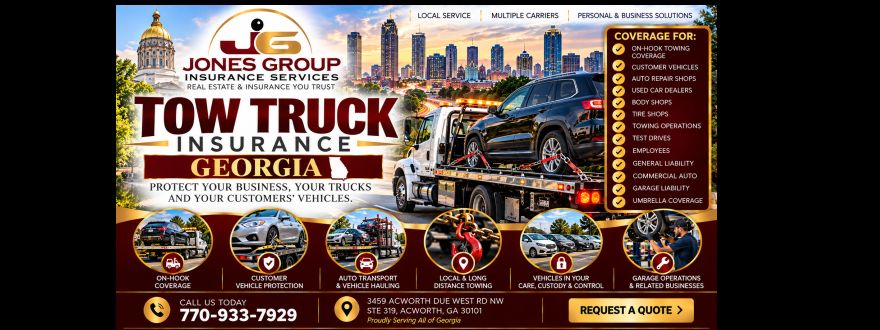
Tow Truck Insurance in Georgia: Why On-Hook Coverage Is Important and How It Differs From Cargo Insurance
If you own a towing company in Georgia, having commercial auto insurance is only part of protecting your business. One of the biggest exposures occurs the moment you hook up, load, or begin transporting someone else's vehicle.
What happens if a customer's vehicle is damaged while you're towing it? What if a vehicle slips from the tow truck, is damaged during transport, or is involved in an accident while in your possession?
This is where on-hook towing coverage can become extremely important.
At Jones Group Insurance Services, we help towing companies and other commercial vehicle businesses throughout Georgia understand the different coverages available to protect their trucks, businesses, and customers' property.
What Is On-Hook Towing Insurance?
On-hook towing insurance is designed to provide coverage for a customer's vehicle while it is being towed or transported by your towing business, subject to the terms, conditions, exclusions, deductibles, and limits of the policy.
Think about it this way: your commercial auto liability coverage primarily addresses liability arising from operation of your insured tow truck. But the vehicle you're towing belongs to someone else.
That customer's vehicle creates a separate exposure.
For example, a towing company picks up a customer's disabled SUV. During the tow, the SUV is damaged as a result of a covered loss. Depending on the circumstances and policy language, on-hook coverage may respond to damage to the vehicle being towed.
That is why towing businesses should not assume their standard commercial auto liability policy automatically provides adequate protection for customers' vehicles.
Why Is On-Hook Coverage Important for Tow Truck Companies?
One damaged vehicle can become an expensive claim.
Today's vehicles can easily be worth $30,000, $50,000, $75,000 or considerably more. Luxury, specialty and commercial vehicles can be worth substantially more.
Without appropriate coverage, a towing company could potentially face a significant financial loss involving a customer's vehicle.
Towing businesses should discuss on-hook coverage when they perform services such as:
- Accident and breakdown towing
- Roadside towing
- Police or municipal towing
- Dealership transportation
- Vehicle recovery
- Flatbed towing
- Wheel-lift towing
- Transportation of customer vehicles
Your insurance agent should understand what types of vehicles you tow, their maximum value, how many vehicles you transport, your towing radius, and your overall operations before determining appropriate coverage options.
On-Hook Insurance vs. Cargo Insurance: What's the Difference?
This is one of the most common areas of confusion for towing and transportation businesses.
On-hook coverage is generally associated with a towing company's responsibility for a customer's automobile while that automobile is being towed or transported.
Motor truck cargo coverage, on the other hand, is generally designed for property or cargo being transported by a motor carrier.
For example, imagine two different businesses.
A towing company uses a rollback to pick up a disabled customer's vehicle and transport it to a repair facility. On-hook coverage may be the applicable coverage to consider for the customer's vehicle.
Now consider a motor carrier hauling merchandise, equipment, building materials, machinery or other goods for customers. Motor truck cargo insurance may be the coverage needed to address the transported property.
The distinction becomes more complicated when a business is transporting automobiles as cargo rather than performing traditional towing operations.
A company transporting multiple vehicles on a car hauler, for example, may have different insurance needs from a local towing company responding to roadside calls.
That is why the actual business operation matters.
What If You Haul Cars on a Flatbed or Car Hauler?
This is where you need to be particularly careful when purchasing insurance.
A business hauling vehicles might describe itself as a "towing company," while an insurance carrier may classify the operation as an auto transporter or motor carrier.
Those classifications can affect which coverage is appropriate.
If you're transporting vehicles for dealerships, auctions, wholesalers, customers or other businesses, tell your insurance agent exactly:
what you're hauling, whose vehicles they are, how many vehicles you carry at once, the maximum value of one vehicle, the maximum total value on the truck or trailer, where you're traveling, and whether you're performing towing, vehicle transport, or both.
Don't simply request "cargo insurance" or "tow truck insurance." Your agent needs to understand the operation so the risk can be submitted correctly to the carrier.
How Much On-Hook Coverage Does a Towing Company Need?
There isn't one appropriate limit for every towing company.
Consider the highest-value vehicle you could reasonably tow.
If your business regularly tows newer luxury vehicles, commercial trucks or expensive specialty vehicles, a low on-hook limit could leave a significant coverage gap.
You should also consider your deductible.
A lower premium isn't necessarily the better insurance program if the coverage limit or deductible doesn't fit your actual exposure.
What About Vehicles Sitting at Your Tow Yard?
This is another important distinction.
A vehicle being towed and a customer's vehicle being stored at your premises may present different insurance exposures.
If your towing company keeps customer vehicles at a tow yard, impound lot, repair facility or other location, tell your insurance agent.
You may need additional coverage for vehicles in your care, custody or control while stored or parked, depending on the nature of your operation and the insurance program.
This is especially important for towing companies that also operate:
auto repair shops, body shops, used-car dealerships, impound lots, storage facilities or other garage operations.
Your business may require a combination of commercial auto, on-hook, garage liability, garagekeepers, property, general liability, workers' compensation, umbrella and other coverages.
Don't Assume On-Hook and Cargo Mean the Same Thing
One of the biggest insurance mistakes a towing business can make is buying coverage based solely on its name.
Insurance policies vary by carrier.
On-hook coverage and motor truck cargo coverage should not automatically be treated as interchangeable.
The correct coverage depends on your business operations, the type of property or vehicles you're transporting, how the transportation is performed, and the actual wording of the insurance policy.
Before binding coverage, make sure your agent understands exactly what your towing company does.
Tow Truck Insurance in Atlanta, Marietta, Acworth, Kennesaw, Woodstock & Canton, GA
Jones Group Insurance Services works with business owners searching for commercial insurance throughout Atlanta, Marietta, Acworth, Kennesaw, Woodstock, Canton, Smyrna, East Cobb, Cobb County, Paulding County and communities throughout Georgia.
Whether you operate one tow truck or a growing fleet, we can help you explore coverage options for your towing operation.
Depending on your business, coverage may include commercial auto liability, physical damage, on-hook towing, motor truck cargo, general liability, garage liability, garagekeepers, workers' compensation and umbrella insurance.
Get a Tow Truck Insurance Quote in Georgia
If you operate a towing company, roadside assistance business, vehicle transport company, car hauler or related automotive business, don't wait until a claim occurs to find out whether your customers' vehicles are properly protected.
Contact Jones Group Insurance Services to discuss your operation and request a commercial insurance quote.
Jones Group Insurance Services
3459 Acworth Due West Rd NW, Suite 319
Acworth, GA 30101
770-933-7929
Serving Atlanta, Marietta, Acworth, Kennesaw, Woodstock, Canton, Smyrna, East Cobb, Cobb County, Paulding County and businesses throughout Georgia