


Long-Haul Commercial Truck Insurance in Georgia: Cargo, Reefer Coverage, Driver Ratings & Proper Classification
Operating a long-haul trucking business involves more than simply purchasing Commercial Auto Liability Insurance.
A trucking company may be responsible for an expensive tractor and trailer, thousands of dollars of someone else's cargo, multiple drivers, and loads traveling hundreds or thousands of miles across state lines.
That's why properly insuring a trucking operation starts with understanding exactly what the business does, what it hauls, where it travels, who drives, and how the insurance carrier classifies the operation.
At Jones Group Insurance Services, we help trucking businesses and owner-operators throughout Georgia understand their commercial trucking insurance options.
Whether you're a new venture, owner-operator, or established trucking company, properly classifying your operation can be just as important as selecting the coverage limits.
What Is Long-Haul Commercial Truck Insurance?
Long-haul commercial truck insurance is designed for trucking businesses that transport property over longer distances, often across multiple states.
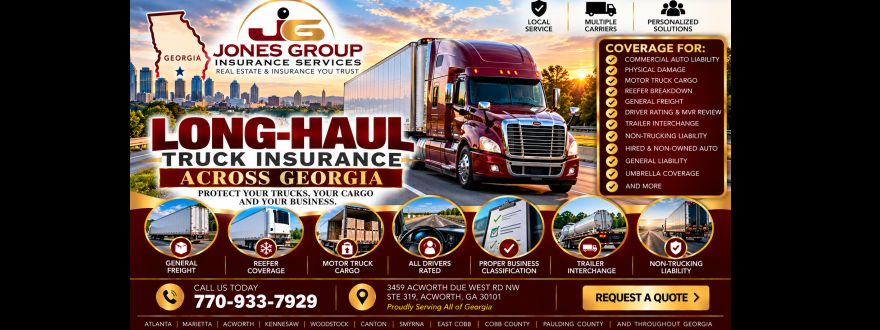
A trucking insurance program may include several different coverages depending on the operation, including:
- Commercial Auto Liability
- Physical Damage
- Motor Truck Cargo
- Reefer Breakdown
- General Liability
- Non-Trucking Liability
- Trailer Interchange
- Hired and Non-Owned Auto
- Uninsured/Underinsured Motorist
- Medical Payments
- Workers' Compensation or Occupational Accident
- Umbrella or Excess Liability
Not every trucking company needs every coverage.
The appropriate insurance program depends heavily on what you're hauling and how your business operates.
Why Is Motor Truck Cargo Insurance Important?
Commercial Auto Liability and Motor Truck Cargo Insurance protect against different exposures.
Commercial Auto Liability generally addresses liability arising from the operation of the insured commercial vehicle, subject to the policy.
Motor Truck Cargo Insurance is designed to address covered loss or damage to property you're transporting for someone else.
For example, imagine you're hauling $75,000 worth of merchandise for a customer.
Your tractor-trailer is involved in an accident, and a significant portion of the load is damaged.
Your Commercial Auto Liability policy should not automatically be assumed to pay for the cargo you're transporting.
That's where Motor Truck Cargo coverage may become important.
Shippers, brokers and motor carriers may also require a certain amount of cargo insurance before allowing a trucking company to haul their freight.
How Much Cargo Coverage Do You Need?
The answer shouldn't simply be:
"Whatever is cheapest."
Your cargo limit should reflect the types and values of loads you actually haul as well as any contractual requirements.
A trucking company hauling relatively inexpensive general merchandise has a different exposure from a carrier hauling electronics, machinery, refrigerated food, pharmaceuticals or other high-value property.
Tell your insurance agent:
What do you haul? What is the maximum value of one load? Who are you hauling for? Are any commodities refrigerated? Are there any high-value or unusual commodities?
Those answers matter.
What Is General Freight?
You'll frequently hear the term general freight when obtaining trucking insurance.
General freight generally refers to a broad category of ordinary commodities being transported rather than a specialized commodity requiring a different underwriting classification.
But this is where trucking companies need to be careful.
"General freight" does not mean "I can haul anything."
An insurance carrier may have specific commodity restrictions or underwriting guidelines.
For example, certain insurers may treat loads involving automobiles, hazardous materials, household goods, livestock, pharmaceuticals, electronics, refrigerated products or other specialized commodities differently.
If your application says you're hauling general freight but your actual operation involves a materially different commodity, you could create a serious underwriting and potential coverage issue.
Always tell your agent what you actually haul.
General Freight vs. Refrigerated Freight
Refrigerated freight—often called reefer freight—creates additional exposures.
A refrigerated trailer may transport:
- Frozen foods
- Meat
- Seafood
- Dairy products
- Produce
- Beverages
- Temperature-sensitive goods
- Other perishable products
The cargo can potentially be damaged without the truck ever being involved in a collision.
Imagine you're transporting $80,000 worth of frozen food.
The refrigeration unit fails overnight.
By the time the problem is discovered, the temperature has risen and the shipment is no longer usable.
A basic cargo policy should not automatically be assumed to cover that loss.
You may need Reefer Breakdown coverage, sometimes referred to as refrigeration breakdown or temperature-change coverage, depending on the carrier and policy.
What Does Reefer Breakdown Coverage Do?
Depending on the policy, Reefer Breakdown coverage may address certain losses to refrigerated cargo caused by a covered failure of the refrigeration equipment.
However, coverage varies significantly.
Policies can contain requirements involving equipment age, maintenance, temperature records, breakdown duration, deductibles, exclusions and covered causes of loss.
If you haul refrigerated freight, tell your insurance agent.
Don't simply say:
"I haul general freight."
Your cargo exposure needs to be classified correctly.
Why Correctly Classifying Your Trucking Business Matters
One of the most important parts of obtaining commercial trucking insurance is proper classification.
Insurance companies don't simply look at the truck.
They look at the entire operation.
Underwriting may consider factors such as:
Commodity hauled, operating radius, states traveled, vehicle type, gross vehicle weight, number of power units, trailers, annual mileage, annual revenue, years in business, DOT information, loss history, driver experience and driving records.
Consider two businesses using similar tractors.
One truck transports local building materials within 50 miles.
Another transports refrigerated food throughout the Southeast.
The vehicles may look similar, but the exposures are very different.
That's why accurately describing the business matters.
Operating Radius Can Affect Your Commercial Truck Insurance
Mileage and operating radius are another major component of trucking insurance.
A local truck operating within a limited radius presents a different exposure from a tractor-trailer traveling across several states.
If your policy is rated for a particular operating radius, make sure that reflects how the truck is actually being used.
If the business expands and starts traveling farther, notify your insurance agent.
Your insurance policy should reflect the operation you are actually running—not the operation you were running when the policy originally started.
Every Driver Matters When Rating Commercial Truck Insurance
Commercial trucking insurance isn't based solely on the business owner.
The carrier needs to know who is actually driving the insured vehicles.
Depending on the carrier, underwriting may consider each driver's:
- Age
- Driver's license status
- CDL classification
- Years of commercial driving experience
- Motor Vehicle Record (MVR)
- Accidents
- Violations
- License suspensions
- Experience with the type of truck being operated
- Employment or driving history
One driver with a poor driving record can potentially affect the company's eligibility or premium.
That's why trucking companies should provide accurate information about all drivers.
Don't Leave Drivers Off the Policy to Try to Lower the Premium
This can create serious problems.
If someone regularly operates a truck for the business, disclose that person to your insurance agent and allow the carrier to determine how the driver should be handled.
The insurance company may require the driver to be listed, rated, approved, excluded where legally and contractually permitted, or otherwise addressed according to the carrier's underwriting rules.
Trying to reduce the premium by failing to disclose a driver can create unnecessary problems when underwriting reviews the account—or after a claim occurs.
What Does "Driver Has Other Coverage" Mean?
This is another area that can cause confusion.
On some commercial auto applications, you may see questions asking whether a driver has other insurance or other coverage.
That does not automatically mean the driver can be ignored or removed from your commercial policy.
"Other coverage" can refer to separate insurance available to that driver, depending on the carrier, policy, vehicle ownership and circumstances.
For example, a person may have a personal auto policy covering their own personal vehicle.
That doesn't necessarily mean their personal policy replaces your business's commercial auto insurance while they're operating your company truck.
Similarly, an owner-operator may have certain coverage under another arrangement, but that doesn't automatically eliminate the need to disclose the driver.
Always tell the commercial carrier who operates the vehicles and let underwriting determine how each driver should be rated.
Why Correct Driver Classification Matters
Insurance companies price commercial trucking risks based partly on who is behind the wheel.
If a business tells the carrier that only one experienced driver operates the truck, but several other drivers regularly use it, the carrier wasn't given an accurate picture of the exposure.
The same principle applies when adding a new driver during the policy term.
Before allowing a new employee to regularly operate an insured commercial truck, contact your insurance agent.
The carrier may need to review the driver's MVR and approve or rate the driver.
Owner-Operator Insurance vs. Motor Carrier Insurance
Owner-operators can also have unique insurance requirements.
The coverage you need may depend on whether you:
Operate under your own authority, lease onto another motor carrier, own the tractor, own the trailer, haul under someone else's authority, or operate independently.
An owner-operator leased to a motor carrier shouldn't assume the motor carrier provides every insurance coverage needed.
For example, the motor carrier may provide certain liability coverage while the owner-operator remains responsible for physical damage, non-trucking liability, occupational accident or other coverages.
Review the lease agreement and insurance requirements carefully.
What Is Non-Trucking Liability?
Non-Trucking Liability is another commonly misunderstood trucking coverage.
It is generally intended for certain liability exposures when the truck is being used for qualifying non-business purposes, subject to the policy's terms.
It should not automatically be described as coverage for every situation where the truck isn't carrying cargo.
Non-Trucking Liability and Bobtail coverage are also terms that can be used differently depending on the insurance carrier and policy form.
Your agent should review how the actual carrier defines the coverage.
What Is Trailer Interchange Insurance?
If you're pulling trailers owned by another company under a trailer interchange agreement, you may need Trailer Interchange coverage.
Physical damage coverage on your tractor does not automatically mean someone else's trailer is covered.
Trucking companies should tell their agent whether they:
own their trailers, lease trailers, interchange trailers, or regularly pull trailers belonging to another motor carrier.
Cheap Truck Insurance Isn't Always the Right Truck Insurance
Commercial trucking premiums can be expensive, so naturally business owners want to save money.
But the cheapest quote isn't necessarily the best quote if the business is classified incorrectly.
Imagine saving money because your policy says:
General freight / 300-mile radius
when you're actually hauling:
Refrigerated freight / interstate long-haul.
Those aren't small differences.
Your insurance should accurately reflect what your trucking company actually does.
Information Needed for a Long-Haul Truck Insurance Quote
When requesting a commercial trucking insurance quote, be prepared to provide your business name and address, DOT and MC numbers if applicable, EIN, years in business, vehicle information, driver information, MVRs, commodities hauled, maximum cargo value, operating radius, states traveled, annual mileage, annual revenue, loss runs, trailer information and current insurance information.
If you're a new venture, tell your agent.
There are insurance markets that consider new trucking businesses, but the underwriting and pricing may differ from an established operation.
Long-Haul Commercial Truck Insurance in Georgia
Jones Group Insurance Services helps trucking businesses and owner-operators explore commercial trucking insurance throughout Georgia, including businesses in Atlanta, Marietta, Acworth, Kennesaw, Woodstock, Canton, Smyrna, East Cobb, Cobb County and Paulding County.
Whether you operate one truck or a growing fleet, we'll take the time to understand what you haul, where you travel, who drives your trucks, and how your operation should be classified.
Coverage options may include Commercial Auto Liability, Physical Damage, Motor Truck Cargo, Reefer Breakdown, Trailer Interchange, Non-Trucking Liability, General Liability, Workers' Compensation and other trucking-related coverages.
Get a Long-Haul Commercial Truck Insurance Quote in Georgia
If you're shopping for long-haul trucking insurance, owner-operator insurance, motor truck cargo insurance or commercial truck insurance in Georgia, contact Jones Group Insurance Services.
The goal isn't simply to find a policy.
It's to make sure the insurance company understands your actual trucking operation so the business is classified and rated appropriately.
Jones Group Insurance Services
3459 Acworth Due West Rd NW, Suite 319
Acworth, GA 30101
770-933-7929
Serving Atlanta, Marietta, Acworth, Kennesaw, Woodstock, Canton, Smyrna, East Cobb, Cobb County, Paulding County and trucking businesses throughout Georgia.