


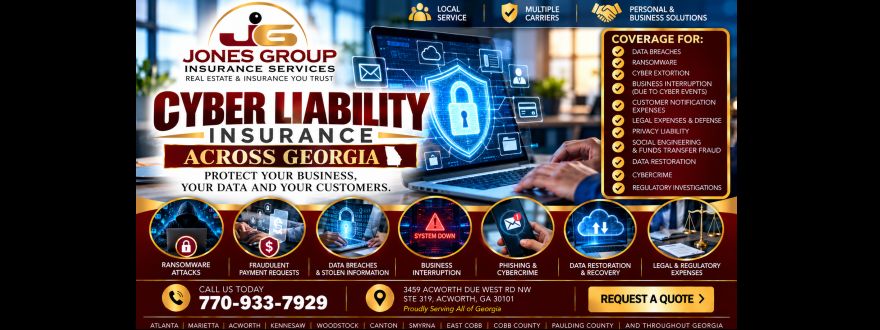
Cyber Liability Insurance in Georgia: What It Covers and Why Businesses Need It
Businesses rely on technology every day.
Customer information is stored electronically. Employees communicate through email. Businesses accept credit cards and electronic payments. Accounting records may be stored in the cloud. Employees log into company systems remotely, and many companies depend on websites, online scheduling systems, payment processors, and other technology to conduct business.
All of this creates a potential cyber exposure.
And cyber attacks aren't limited to large corporations.
A small business can experience a phishing attack, ransomware incident, stolen password, fraudulent email, data breach, or other cyber event that can quickly become expensive.
That's why Cyber Liability Insurance has become an important coverage for businesses in Georgia.
At Jones Group Insurance Services, we help business owners understand their cyber exposures and explore coverage options designed to protect their companies when technology and sensitive information are compromised.
What Is Cyber Liability Insurance?
Cyber Liability Insurance is designed to help businesses respond to certain losses resulting from cyberattacks, data breaches, privacy incidents, ransomware, and other technology-related events, depending on the policy.
Cyber insurance can potentially provide both first-party and third-party coverage.
First-party coverage generally relates to losses your own business experiences following a covered cyber event.
Third-party coverage generally relates to claims or lawsuits brought against your business because of an alleged privacy or data-security failure.
The exact coverage varies significantly between insurance companies, so it's important to review the actual policy.
What Can Cyber Liability Insurance Cover?
Depending on the carrier and policy selected, Cyber Liability Insurance may provide coverage for expenses involving:
- Data breaches and privacy incidents
- Ransomware and cyber extortion
- Data restoration and recovery
- Business interruption caused by certain cyber events
- Computer forensic investigations
- Customer notification expenses
- Credit or identity monitoring expenses
- Legal expenses and defense costs
- Privacy liability
- Network security liability
- Regulatory investigations and certain covered expenses
- Public relations or crisis-management expenses
- Social engineering and funds-transfer fraud, when specifically included
- Cybercrime, depending on the policy
Not every cyber policy includes every one of these protections.
For example, social engineering and fraudulent funds transfer coverage may have separate limits, conditions, or exclusions.
That's one reason businesses shouldn't purchase cyber insurance based on price alone.
Why Would a Small Business Need Cyber Insurance?
A common misconception is:
"My company is too small for hackers to care about."
Unfortunately, a cybercriminal doesn't necessarily need to specifically target your company.
Employees can receive automated phishing emails designed to steal Microsoft 365, Google, banking, or other login credentials.
A business can also experience a cyber incident because an employee accidentally clicks a malicious link, sends confidential information to the wrong person, uses a compromised password, or responds to a fraudulent payment request.
Even a small cyber event can result in expenses for IT specialists, attorneys, customer notifications, data recovery, business interruption, and other costs.
Cyber Claim Example #1: The Fake Vendor Email
Imagine a Georgia business regularly pays one of its vendors electronically.
An employee receives an email that appears to come from the vendor.
The email says:
"We've changed banks. Please send future payments to our new account."
The employee changes the banking information and sends a $35,000 payment.
Days later, the real vendor calls asking why its invoice hasn't been paid.
The company discovers the email was fraudulent.
The $35,000 was sent to a cybercriminal.
This type of loss can involve social engineering or funds-transfer fraud.
However, businesses need to be careful: not every cyber policy automatically covers this type of incident.
The policy must be reviewed to determine whether social engineering or fraudulent transfer coverage is included and what limit applies.
Cyber Claim Example #2: Ransomware Shuts Down the Business
Imagine an employee clicks a link in what appears to be a legitimate email.
Malicious software enters the company's computer system and encrypts important files.
Employees suddenly cannot access customer records, invoices, scheduling systems, or other business information.
A message appears demanding payment to restore access.
The company may now need cybersecurity professionals, forensic investigators, attorneys, data restoration services, and potentially other specialists.
The business could also lose income while its systems are unavailable.
Depending on the cyber policy and circumstances, coverage may be available for certain ransomware, cyber extortion, data restoration, forensic investigation, and business interruption expenses.
Cyber Claim Example #3: Customer Information Is Stolen
Suppose a business stores customers' names, addresses, dates of birth, payment information, or other personally identifiable information.
A hacker gains unauthorized access to the system and steals customer records.
Now the business may need to determine:
What information was compromised?
How many people were affected?
Do customers need to be notified?
Does the business need legal counsel?
Is identity or credit monitoring required?
A cyber policy may help with certain costs associated with investigating and responding to a covered data breach.
Without appropriate insurance, those expenses may fall directly on the business.
Cyber Claim Example #4: An Employee's Email Is Hacked
A cybercriminal obtains an employee's email password.
The criminal begins monitoring conversations between the employee, customers, vendors, and management.
Eventually, the criminal learns that the company is preparing to make a large payment.
The criminal impersonates someone involved in the transaction and provides fraudulent payment instructions.
The company sends the money to the wrong account.
This is another example of why businesses should discuss social engineering, business email compromise, and funds-transfer fraud when purchasing cyber coverage.
Simply having a policy called "Cyber Liability" does not guarantee that every type of cybercrime is covered.
Cyber Claim Example #5: A Cyberattack Stops Business Operations
Imagine a company's network or cloud-based system becomes unavailable because of a covered cyberattack.
Employees cannot access important systems, process orders, schedule customers, or perform normal operations.
The company may lose revenue for several days.
Some cyber policies can provide business interruption coverage following certain covered cyber events.
The policy may contain a waiting period, deductible, coverage limit, and specific requirements before coverage applies.
Doesn't General Liability Cover Cyber Claims?
This is an important question.
Business owners sometimes assume their General Liability Insurance will cover a data breach or cyberattack.
You should not assume that it does.
General Liability Insurance is primarily designed for certain claims involving bodily injury, property damage, and personal or advertising injury.
Cyber incidents involve specialized exposures such as electronic data, privacy violations, network security, ransomware, cybercrime, and technology failures.
That's why Cyber Liability Insurance is generally written as a separate coverage or specialized endorsement.
What Businesses Should Consider Cyber Liability Insurance?
Cyber coverage isn't just for technology companies.
If your business stores customer information, accepts electronic payments, uses email, maintains employee information, has a website, uses cloud-based software, conducts online banking, or depends on computers to operate, you have some level of cyber exposure.
That can include:
Insurance agencies, real estate companies, contractors, restaurants, home health care agencies, medical businesses, accounting firms, law offices, trucking companies, auto dealerships, repair shops, retailers, professional offices, nonprofit organizations, property managers, and many other businesses.
Consider a home health care agency, for example.
The business may maintain employee records and sensitive client information. A data breach could potentially expose information belonging to numerous clients and employees.
Or consider an insurance agency.
An agency may maintain customers' names, addresses, driver's license information, dates of birth, insurance records, payment information, and other confidential data.
The business's cyber exposure can be significant even though it isn't a technology company.
Cyber Liability vs. Crime Insurance
These coverages can sometimes overlap, but they aren't necessarily the same.
Cyber Liability Insurance generally focuses on cyber events, privacy breaches, network security incidents, ransomware, data restoration, and related exposures.
Commercial Crime Insurance may address certain losses involving employee dishonesty, theft, forgery, fraud, and other crimes.
Some cyber policies provide certain cybercrime protections, while others require additional endorsements.
If you're particularly concerned about social engineering, fraudulent wire transfers, or employees being tricked into sending money, ask your agent specifically whether those exposures are covered.
Don't assume they're included simply because the policy says "Cyber."
How Much Cyber Insurance Does a Business Need?
There isn't one appropriate cyber liability limit for every company.
The amount of coverage you should consider depends on factors such as:
Annual revenue, number of customers, type of information stored, number of employees, payment processing, online transactions, industry, contractual requirements, and the potential financial impact if your systems become unavailable.
A business handling sensitive customer information may have very different cyber exposure from a company that stores very little personal information.
Your insurance agent should understand how your business operates before recommending coverage options.
Ways Businesses Can Reduce Cyber Risk
Insurance is one part of cyber risk management.
Businesses should also consider basic cybersecurity practices such as:
- Using multi-factor authentication (MFA)
- Creating strong, unique passwords
- Training employees to recognize phishing emails
- Verifying changes to vendor banking information by phone
- Maintaining secure backups
- Keeping software and operating systems updated
- Restricting employee access to sensitive information
- Using reputable cybersecurity and antivirus tools
- Having a plan for responding to a cyber incident
One simple rule can prevent a costly mistake:
Never change payment or banking instructions based solely on an email.
Verify the request using a trusted telephone number you already have for the person or company.
Cyber Liability Insurance in Georgia
Jones Group Insurance Services helps businesses explore Cyber Liability Insurance throughout Georgia, including businesses in Atlanta, Marietta, Acworth, Kennesaw, Woodstock, Canton, Smyrna, East Cobb, Cobb County, and Paulding County.
Whether you operate a small business with a few employees or an established company handling large amounts of customer information, cyber coverage should be part of your commercial insurance conversation.
Cyber Liability Insurance may be available as a standalone policy or as part of a broader commercial insurance program, depending on the business and carrier.
Get a Cyber Liability Insurance Quote in Georgia
A cyberattack can happen quickly.
The time to find out whether your business has adequate cyber protection is before an employee clicks a malicious link, a hacker accesses customer information, or money is transferred to a fraudulent account.
Contact Jones Group Insurance Services to discuss Cyber Liability Insurance for your Georgia business.
Jones Group Insurance Services
3459 Acworth Due West Rd NW, Suite 319
Acworth, GA 30101
770-933-7929
Serving Atlanta, Marietta, Acworth, Kennesaw, Woodstock, Canton, Smyrna, East Cobb, Cobb County, Paulding County, and businesses throughout Georgia.