


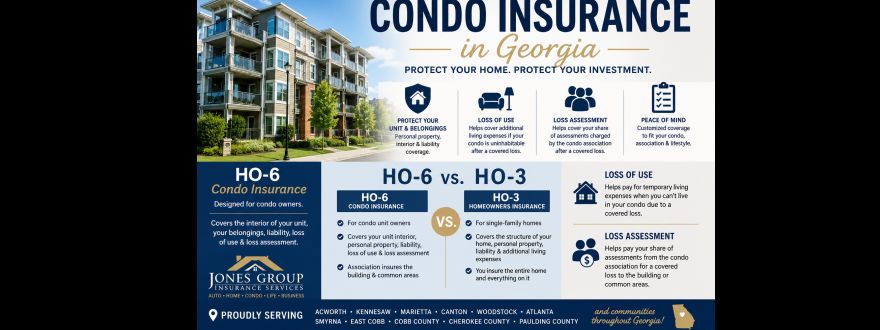
Condo Insurance in Georgia: HO-6 vs. HO-3, Loss of Use & Loss Assessment Explained
If you own a condominium in Georgia, you may assume that your condo association’s master insurance policy provides all the protection you need. Unfortunately, that is not always the case.
A condo association’s master policy generally provides insurance for certain portions of the building and common property, while an individual condo owner may still be responsible for protecting the inside of the unit, personal belongings, personal liability, additional living expenses, and other exposures.
That is where an HO-6 Condo Insurance Policy comes in.
At Jones Group Insurance Services, we help condo owners throughout Georgia understand what their association covers, what they are responsible for, and how to choose the right amount of individual condo insurance.
We proudly assist clients in Acworth, Kennesaw, Marietta, Canton, Woodstock, Atlanta, Cobb County, Cherokee County, Paulding County, East Cobb, Smyrna, and communities throughout Georgia.
What Is HO-6 Condo Insurance?
An HO-6 policy, commonly called condo insurance or unit-owners insurance, is designed specifically for people who own a condominium or similar unit.
Unlike a traditional homeowners policy that may insure the entire house structure, condo ownership typically involves two layers of insurance:
1. The Condo Association's Master Policy
The condominium association generally carries a master insurance policy covering certain portions of the building and common areas.
Depending on the association and its governing documents, this could include areas such as the roof, exterior structure, hallways, elevators, clubhouse, pool, or other property owned collectively by the association.
2. Your Individual HO-6 Policy
Your HO-6 policy is designed to protect exposures that are your responsibility as the individual unit owner.
Depending on the policy and association requirements, an HO-6 may provide coverage for:
-
Interior portions of your condo for which you are responsible
-
Furniture, clothing, electronics and other personal belongings
-
Improvements and upgrades you've made to your unit
-
Personal liability
-
Medical payments to others
-
Loss of use/additional living expenses
-
Loss assessment
-
Theft and certain covered water losses
-
Additional optional coverages and endorsements
Important: Every condominium association is different. Before determining how much HO-6 coverage you need, your insurance agent should review what the association's master policy covers and, when available, the insurance requirements contained in the condo documents.
HO-6 vs. HO-3: What's the Difference?
This is one of the most common questions we receive.
Although both are forms of property insurance, an HO-3 homeowners policy and HO-6 condo policy are designed for different types of property ownership.
HO-3 Homeowners Insurance
An HO-3 is commonly used for a traditional single-family home.
Because the homeowner generally owns the house itself, the policy typically provides substantial dwelling coverage for the home's structure in addition to coverage for personal property, liability and additional living expenses, subject to the terms, limits, deductibles and exclusions of the policy.
For example, if you own a detached home in Acworth, Kennesaw, Marietta, Canton or Woodstock, an HO-3 may be the type of homeowners policy used to insure the residence.
HO-6 Condo Insurance
An HO-6 is designed for a condominium unit owner.
With a condo, the association generally insures certain portions of the overall building while the HO-6 policy protects the individual owner's interests.
That makes determining the correct amount of Coverage A – Building Property on an HO-6 especially important.
The amount should not simply be guessed.
Your agent needs to understand where the condo association's responsibility ends and your responsibility begins.
Why Do I Need Condo Insurance if My HOA Already Has Insurance?
Think of the association's master policy and your HO-6 policy as two pieces of the insurance puzzle.
The association may insure the building, but that does not necessarily mean its policy protects:
-
Your furniture
-
Your clothing
-
Your televisions and electronics
-
Your personal liability
-
Your temporary housing expenses
-
Improvements or upgrades inside your unit
-
Your financial responsibility for certain association assessments
For example, imagine a covered fire damages your condominium building.
The association's policy may respond to covered damage for which the association is responsible, but you could still have damage to your personal property, portions of the interior that are your responsibility, and expenses from temporarily living somewhere else.
Those are some of the reasons an individual HO-6 condo policy is so important.
Loss of Use vs. Loss Assessment on an HO-6 Policy
These two coverages sound similar, but they serve completely different purposes.
Understanding the difference is extremely important for Georgia condo owners.
What Is Loss of Use?
Loss of Use generally helps with additional living expenses when a covered loss makes your condo uninhabitable, subject to your policy's terms and limits.
Let's say there is a covered fire in your condo building and you cannot safely live in your unit while repairs are being made.
You may temporarily need:
-
A hotel
-
An apartment or rental home
-
Additional meal expenses
-
Other qualifying increased living expenses
Loss of Use coverage may help with eligible additional expenses resulting from the covered loss.
In simple terms:
Loss of Use = "I can't live in my condo because of a covered loss. Where am I going to stay?"
It protects you and your living situation.
What Is Loss Assessment?
Loss Assessment is different.
Loss Assessment coverage may help pay your share of certain assessments charged to unit owners by the condominium association following a covered loss, subject to the HO-6 policy's terms, limits and exclusions.
Here's an example:
Suppose a covered fire causes major damage to a common area of your condominium complex.
The condo association has insurance, but there may be costs that are not fully covered by the association's policy.
If the association properly assesses the unit owners for their share of an eligible covered loss, your portion could potentially be thousands of dollars.
Depending on the cause of loss, your policy and the amount of Loss Assessment coverage you've purchased, your HO-6 policy may help with your portion.
In simple terms:
Loss Assessment = "My condo association assessed the owners for a covered loss. What do I owe?"
It protects you from certain qualifying assessments from the association.
Loss of Use vs. Loss Assessment — An Easy Way to Remember
LOSS OF USE
Think: "Where will I live?"
This coverage may help with additional living expenses when you cannot live in your condo because of a covered loss.
LOSS ASSESSMENT
Think: "What is the HOA charging me?"
This coverage may help with your share of certain covered assessments imposed by the condominium association.
They are two completely different protections, and both can be extremely important for a condo owner.
Don't Assume the Basic Loss Assessment Limit Is Enough
This is an area condo owners should pay particular attention to.
Some policies may include only a relatively small amount of Loss Assessment coverage automatically, although higher limits may be available by endorsement depending on the insurance carrier.
Imagine receiving a $10,000, $25,000 or larger association assessment and then discovering that your individual policy provides only a small amount of applicable Loss Assessment coverage.
That's why we recommend discussing your Loss Assessment limit rather than simply accepting the default amount without reviewing it.
Your condo association's master policy, deductibles and governing documents can help you and your agent evaluate your exposure.
What About the Condo Association's Master Policy Deductible?
This is another important question to ask.
Condo association master policies can carry significant deductibles.
Depending on the circumstances, governing documents, applicable law, cause of loss and insurance policies involved, unit owners could potentially face financial responsibility associated with a loss.
When reviewing condo insurance, ask:
-
What does the association's master policy cover?
-
What is the association's property deductible?
-
What portions of my unit am I responsible for?
-
Can the association assess unit owners after certain losses?
-
How much Loss Assessment coverage do I have?
-
Does my HO-6 policy provide appropriate building property coverage?
-
What water-related losses are covered or excluded?
-
Do I need water backup coverage?
-
Do I need separate flood insurance?
These questions can be just as important as asking, "How much is the premium?"
Does HO-6 Condo Insurance Cover Flooding?
Do not automatically assume that it does.
Standard homeowners and condo policies generally do not provide coverage for flooding as defined under flood insurance policies.
A separate flood insurance policy may be necessary.
This is important even if your condo isn't directly on a lake, river or coastline. Flooding can occur in many areas, and your lender or condo association's insurance does not necessarily eliminate your individual exposure.
What About Water Backup?
Water backup is another coverage condo owners should discuss with their agent.
Damage resulting from water backing up through a sewer or drain can be treated differently from other types of water damage.
Depending on your insurance company, water backup coverage may need to be added by endorsement.
Don't wait until you have water on your floor to find out how your policy responds.
How Much HO-6 Insurance Do I Need?
There isn't one number that's right for every Georgia condo owner.
Your coverage should be based on factors such as:
-
Your condo association's master insurance policy
-
The association's bylaws and insurance responsibilities
-
Value of your personal belongings
-
Interior finishes and improvements
-
Replacement cost of portions of the unit you're responsible for
-
Personal liability exposure
-
Loss Assessment exposure
-
Master policy deductibles
-
Your mortgage lender's requirements
This is why comparing condo insurance based solely on price can be a mistake.
A policy that costs a little less but leaves significant gaps may become very expensive when a claim occurs.
Condo Insurance Throughout Georgia
Whether you are buying your first condo, reviewing an existing HO-6 policy, or simply aren't sure whether your current coverage is adequate, Jones Group Insurance Services can help.
We work with condo owners throughout Georgia, including:
Acworth • Kennesaw • Marietta • Canton • Woodstock • Atlanta • Smyrna • East Cobb • Cobb County • Cherokee County • Paulding County and surrounding Georgia communities.
As an independent insurance agency, we can help review your coverage needs and shop available insurance options to find the combination of coverage, protection and price that works for you.
Need a Georgia Condo Insurance Quote?
Don't wait until a claim happens to discover that there is a gap between your condo association's insurance and your individual coverage.
Let Jones Group Insurance Services review your current HO-6 policy or help you obtain a new condo insurance quote.
We can help you understand:
HO-6 Condo Insurance • Loss Assessment • Loss of Use • Personal Property • Liability • Water Backup • Flood Insurance • Building Property Coverage
Contact Jones Group Insurance Services today for a Georgia condo insurance quote.
Serving Acworth, Kennesaw, Marietta, Canton, Woodstock, Atlanta, Smyrna, East Cobb, Cobb County, Cherokee County, Paulding County and clients throughout Georgia.
Insurance coverage varies by carrier and policy. All coverage is subject to the terms, conditions, limits, deductibles and exclusions of the applicable insurance policy. Association assessments are not automatically covered simply because an HOA or condominium association charges them.