


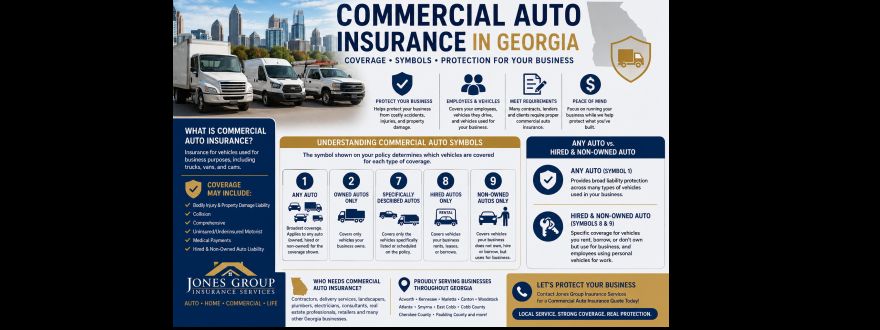
Commercial Auto Insurance in Georgia: Coverage, Insurance Symbols & Hired and Non-Owned Auto Explained
If you use a vehicle for business, your personal auto insurance may not provide the protection your company needs.
Whether you own a construction company with several work trucks, operate a delivery business, have employees driving company vehicles, or occasionally rent or borrow vehicles for business purposes, having the right commercial auto insurance in Georgia can be an important part of protecting your business.
At Jones Group Insurance Services, we help businesses in Acworth, Kennesaw, Marietta, Canton, Woodstock, Atlanta, Smyrna, East Cobb, Cobb County, Cherokee County, Paulding County and throughout Georgia understand their commercial auto coverage and choose insurance appropriate for their operations.
What Is Commercial Auto Insurance?
Commercial auto insurance is designed to insure vehicles used for business purposes and the liability exposures associated with operating those vehicles.
A commercial auto policy may cover vehicles such as:
-
Work trucks
-
Vans
-
Service vehicles
-
Company cars
-
Delivery vehicles
-
Contractor vehicles
-
Certain trailers
-
Fleets of business vehicles
The exact coverage depends on the policy, vehicles, drivers, business operations and the coverage symbols shown on the policy.
Why Is Commercial Auto Insurance Important?
A serious auto accident can create a significant financial loss for a business.
Imagine one of your employees is driving a company truck to a jobsite and causes an accident involving another vehicle.
There could be:
-
Injuries to other people
-
Damage to another vehicle
-
Damage to other property
-
Legal expenses
-
Damage to your company vehicle
-
Medical expenses
-
Lost income or other damages claimed by an injured party
Without appropriate commercial auto insurance, your business could be exposed to substantial out-of-pocket expenses.
For contractors, landscapers, electricians, plumbers, delivery companies, service businesses and many other Georgia businesses, vehicles are essential to everyday operations. The insurance protecting those vehicles should be treated as an important part of the company's risk-management plan.
What Does Commercial Auto Insurance Cover?
A commercial auto policy can include several different types of coverage.
Bodily Injury and Property Damage Liability
Auto liability coverage can help protect your business when a covered driver is legally responsible for an accident that causes bodily injury or property damage to someone else.
This is one of the most important components of a commercial auto policy.
Collision Coverage
Collision coverage generally helps pay for covered physical damage to an insured vehicle resulting from a collision with another vehicle or object, subject to the policy deductible and terms.
Comprehensive Coverage
Comprehensive coverage generally protects against certain covered losses other than collision, such as:
-
Theft
-
Vandalism
-
Fire
-
Falling objects
-
Certain weather-related losses
-
Glass damage
Coverage varies by policy and carrier.
Uninsured/Underinsured Motorist Coverage
Uninsured or underinsured motorist coverage can provide protection when an insured is injured or suffers covered damages involving a driver who has no insurance or insufficient insurance, subject to the policy and applicable Georgia law.
Medical Payments or Other Injury-Related Coverage
Depending on the policy and state requirements, additional injury-related coverage may also be available.
Hired and Non-Owned Auto Liability
Businesses that don't own every vehicle used in their operations should pay particular attention to Hired and Non-Owned Auto, often abbreviated HNOA.
We'll explain this in more detail below.
What Do the Commercial Auto Insurance Symbols Mean?
One of the most confusing parts of a commercial auto policy is the covered auto symbols.
You may look at your declarations page and see numbers such as:
Symbol 1, Symbol 2, Symbol 7, Symbol 8 or Symbol 9.
Those numbers are extremely important because they help determine which autos qualify as covered autos for a particular coverage.
A business should not assume that simply having a commercial auto policy means every vehicle connected to the business is covered for every coverage.
Symbol 1 – Any Auto
Symbol 1 generally means “Any Auto.”
This is the broadest standard covered-auto designation and can apply to liability coverage when shown for that coverage.
It can encompass owned, hired and non-owned autos for the applicable coverage, subject to the policy's terms and exclusions.
Symbol 1 is particularly valuable because a business's auto exposure isn't always limited to vehicles specifically listed on the policy.
However, Symbol 1 does not automatically mean every coverage on the policy applies to every auto.
You must look at the symbol shown next to each individual coverage.
Symbol 2 – Owned Autos Only
Symbol 2 generally means “Owned Autos Only.”
This applies to autos the insured owns, subject to the policy definitions and terms.
It does not provide the same broad reach as Symbol 1.
Symbol 7 – Specifically Described Autos
Symbol 7 generally means “Specifically Described Autos.”
This is very common on commercial auto policies.
Coverage generally applies to the autos specifically scheduled or described for that coverage under the policy, subject to policy provisions.
For example, if your business owns three work trucks but only two are properly scheduled for a particular coverage, you should not automatically assume the third vehicle has identical protection.
That is why businesses should notify their insurance agent when vehicles are purchased, sold or replaced.
Symbol 8 – Hired Autos Only
Symbol 8 generally means “Hired Autos Only.”
This generally relates to certain vehicles the business leases, hires, rents or borrows, subject to the policy definition and exclusions.
For example, your company may rent a vehicle while a company truck is being repaired.
Depending on the policy and coverage selected, hired auto coverage may become important.
Symbol 9 – Non-Owned Autos Only
Symbol 9 generally means “Non-Owned Autos Only.”
This generally applies to certain vehicles the business does not own, lease, hire, rent or borrow but that are used in connection with the business.
A common example is an employee using his or her personal vehicle for company business.
This can create an exposure that business owners sometimes overlook.
Why Are Commercial Auto Symbols So Important?
Because the symbol can determine which autos are covered for a specific coverage.
Your declarations page might show one symbol for liability and another symbol for physical damage.
For example, a policy could potentially show broader coverage for liability while collision and comprehensive coverage apply only to specifically described vehicles.
This is why you should never look only at the premium or liability limit when reviewing a commercial auto quote.
You should also ask:
-
Which covered-auto symbols apply?
-
Are all company-owned vehicles properly listed?
-
Are employees using personal vehicles for work?
-
Does the company rent vehicles?
-
Does the company borrow vehicles?
-
Are newly acquired vehicles handled properly?
-
Who is driving the vehicles?
-
Are trailers being used?
-
Do we have Hired and Non-Owned Auto exposure?
Any Auto vs. Hired and Non-Owned Auto: What's the Difference?
This is an important distinction.
Any Auto – Symbol 1
When Symbol 1 – Any Auto applies to liability, it is generally broader than coverage limited to only owned, hired or non-owned categories.
In simple terms:
Any Auto = potentially broad liability protection across multiple categories of autos, subject to the policy.
Hired Auto – Symbol 8
Hired Auto generally addresses certain autos the business leases, hires, rents or borrows.
Think:
“The business doesn't own it, but the business rented or hired it.”
Non-Owned Auto – Symbol 9
Non-Owned Auto generally addresses certain autos the business does not own but that are used in connection with the business.
A common example:
An employee drives their own personal car to perform an errand or other business activity for the company.
Think:
“The business doesn't own the car, but it's being used for company business.”
Example: Employee Uses a Personal Vehicle for Business
Suppose you own a business in Marietta and ask an employee to drive their personal vehicle to pick up supplies for the company.
The employee causes an accident while completing the business errand.
The employee may have personal auto insurance, but the accident could also create liability exposure for your company.
This is one reason businesses should discuss Non-Owned Auto Liability with their insurance agent.
Simply telling employees to use their own vehicles does not necessarily eliminate the company's exposure.
Example: Your Business Rents a Vehicle
Suppose your contractor business in Canton or Woodstock rents a truck or van for several days because one of your regular vehicles is unavailable.
That creates a different exposure.
Hired Auto coverage may be relevant because the business is using a rented or hired vehicle.
It's also important to distinguish Hired Auto Liability from Hired Auto Physical Damage.
Liability coverage addresses liability to others. It does not necessarily mean damage to the rented vehicle itself is covered.
Ask your agent specifically how your policy responds.
Does Hired and Non-Owned Auto Cover Employee Vehicles for Physical Damage?
This is another common misunderstanding.
Non-Owned Auto Liability generally should not be assumed to provide physical damage coverage for an employee's personal vehicle.
The employee's own personal auto policy may be the policy that responds to physical damage to their vehicle, depending on the circumstances and coverage.
Likewise, Hired Auto Liability does not automatically mean you have physical damage coverage for a vehicle your business rents.
These distinctions are important.
Do I Need Commercial Auto Insurance if I Only Have One Business Vehicle?
Possibly.
Commercial auto insurance isn't only for companies with large fleets.
A small contractor with one pickup truck can still have significant business auto exposure.
The correct policy depends on factors such as:
-
Who owns the vehicle
-
How the vehicle is titled
-
How it is used
-
Who drives it
-
How often it is used for business
-
What equipment or materials it carries
-
Whether employees drive it
-
Whether vehicles are rented or borrowed
-
Whether employees use personal vehicles for business
Don't assume a personal auto policy is appropriate simply because your company owns only one vehicle.
What Businesses Should Consider Commercial Auto Insurance?
Many Georgia businesses may have a commercial auto exposure, including:
-
General contractors
-
Electricians
-
Plumbers
-
HVAC contractors
-
Landscapers
-
Roofers
-
Painters
-
Mobile welders
-
Cleaning companies
-
Delivery businesses
-
Restaurants
-
Home healthcare companies
-
Real estate businesses
-
Consulting companies
-
Retail businesses
-
Auto dealers and repair businesses
-
Companies with salespeople or employees driving for work
Even a business that owns no vehicles may still have an auto liability exposure if employees regularly use personal vehicles for company business.
Commercial Auto Insurance for Georgia Contractors
Contractors should pay particularly close attention to commercial auto insurance.
A contractor may have trucks traveling between the office, supply houses and multiple jobsites every day.
Vehicles may also carry:
-
Tools
-
Equipment
-
Materials
-
Ladders
-
Trailers
Commercial auto insurance protects the vehicle-related exposure, but remember that tools and equipment carried inside a vehicle may require separate inland marine, tools and equipment, or other property coverage.
Don't automatically assume everything inside your work truck is covered by the commercial auto policy.
Commercial Auto Insurance Throughout Georgia
At Jones Group Insurance Services, we help business owners understand more than just the price of a commercial auto policy.
We can help you review:
-
Commercial Auto Liability
-
Comprehensive and Collision
-
Covered Auto Symbols
-
Any Auto – Symbol 1
-
Specifically Described Autos – Symbol 7
-
Hired Auto – Symbol 8
-
Non-Owned Auto – Symbol 9
-
Hired and Non-Owned Auto Liability
-
Uninsured/Underinsured Motorist Coverage
-
Business vehicle and driver exposures
We proudly serve businesses in:
Acworth • Kennesaw • Marietta • Canton • Woodstock • Atlanta • Smyrna • East Cobb • Cobb County • Cherokee County • Paulding County and throughout Georgia.
Need a Commercial Auto Insurance Quote in Georgia?
Whether you operate one work truck or an entire fleet, having the right commercial auto coverage can help protect the business you've worked hard to build.
Don't wait until an accident occurs to discover that the vehicle involved wasn't covered the way you expected.
Contact Jones Group Insurance Services today for a commercial auto insurance review or quote.
We can help evaluate your vehicles, drivers, liability limits, covered-auto symbols, hired auto and non-owned auto exposures to determine which coverage options may be appropriate for your business.
Jones Group Insurance Services
Serving Acworth, Kennesaw, Marietta, Canton, Woodstock, Atlanta, Smyrna, East Cobb, Cobb County, Cherokee County, Paulding County and businesses throughout Georgia.
Coverage descriptions are general summaries only. Actual coverage depends on the insurance carrier, policy form, endorsements, covered-auto symbols, limits, deductibles, exclusions and the specific facts of a claim. Consult your policy and insurance professional for coverage applicable to your business.